A temperature and humidity sensor with the transmitter built into the probe, so one four-wire cable carries both power and data. The electronics are the same in every version. The housing is chosen for the air it has to sit in.
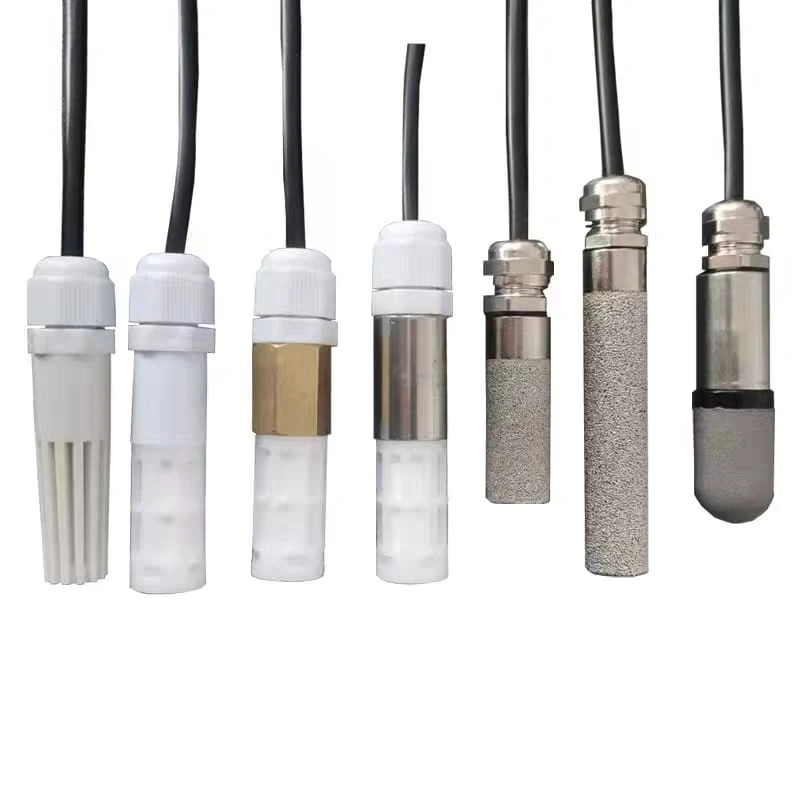
A vented cap for dry indoor air, sealed and metal bodies for wet and outdoor air, sintered filters for dust, and an IP67 housing for washdown. Specifications and communication are the same in all of them.
A wide 5 to 28 V DC supply with reverse polarity protection, and an RS485 bus that runs up to 2000 m with proper cabling and termination.
A temperature offset and a humidity offset can be written to the sensor, so a reading is brought into line with a reference without replacing anything.
| Temperature range | -40 to +80 °C |
|---|---|
| Temperature accuracy | ±0.3 °C (at 25 °C) |
| Temperature resolution | 0.1 °C |
| Humidity range | 0-100% RH (non-condensing) |
| Humidity accuracy | ±3% RH (at 60% RH, 25 °C) |
| Humidity resolution | 0.1% RH |
| Response time | ≤15 s temperature, ≤4 s humidity (1 m/s airflow) |
| Measurement refresh | 2 s |
| Long-term stability | ≤0.1 °C/year, ≤1% RH/year |
| Output | RS485, Modbus RTU |
| Supply voltage | 5-28 V DC |
| Power consumption | ≤0.05 W |
| Protection | Reverse polarity protection on the supply |
| Cable | 4-wire, 1 m standard |
Response time is specified with the vented cap. Sealed and sintered housings protect the element in wet and dusty air and respond more gradually to fast humidity changes.
| Housing | Dimensions | Environment |
|---|---|---|
| Vented PVC cap | Ø12.5 × 68 mm | Indoor air, fastest response, not waterproof |
| Sealed polymer | Ø15 × 67 mm | High humidity and outdoor, rain and fog |
| Brass body | Ø15 × 68 mm | High humidity and outdoor, rain and fog |
| Stainless steel body | Ø15 × 76 mm | High humidity and outdoor, rain and fog |
| Sintered metal filter | Ø14 × 57 mm | High dust, fast response |
| Sintered metal filter, long | Ø14 × 87 mm | High dust |
| IP67 sintered housing | Ø16.5 × 74 mm | Harsh and washdown environments |
The sensor is a standard Modbus device. What it is connected to decides what the reading is worth.
The RS485 output connects to a Genesis controller alongside every other Modbus sensor on the site. Each device has its own address, and each reading is filed against its own location.
The controller sends readings over 4G-LTE on battery, solar or a DC supply. Through an outage it holds them and sends them in order when the link returns.
Charts, threshold alerts to the right person, export to Excel, and a REST API for your own systems.
The output is standard Modbus RTU, so the sensor also reads into any PLC or controller that speaks it.
Function 0x03 reads the measurement registers. Several sensors share one RS485 pair, each with its own address.
| Protocol | Modbus RTU |
|---|---|
| Serial settings | 9600 bps default, 8 data bits, no parity, 1 stop bit |
| Default address | 0x01 |
| Address | Content | Scaling |
|---|---|---|
| 0x0000 | Humidity | Value ÷ 10 (% RH) |
| 0x0001 | Temperature | Value ÷ 10 (°C), two's complement below 0 °C |
Request: 01 03 00 00 00 02 C4 0B
Response: 01 03 04 01 E6 FF 9F 1B A0 In this response 0x01E6 is 486, which is 48.6% RH, and 0xFF9F is -97, which is -9.7 °C.
The IP67 sintered housing. The vented PVC cap responds fastest but is not waterproof, so it belongs in dry indoor air.
The RS485 bus runs up to 2000 m with proper cabling and termination. On a long run, power the sensors locally and fit a 120 Ω termination resistor at the far end.
Yes, down to -40 °C. A negative temperature is sent in two's complement, which the controller decodes.
The stated long-term stability is 0.1 °C and 1% RH a year or better. A reading can also be trimmed against a reference by writing an offset to the sensor.
The points, the ranges and where they sit. You get back which sensors fit and how they wire into the controller.
Talk to us →