Insertion electromagnetic flow meter

A flow meter for large pipes that goes in through a ball valve, so it is fitted and withdrawn without stopping the flow. It has no moving parts and causes almost no pressure drop, on any conductive liquid from 30 µS/cm.

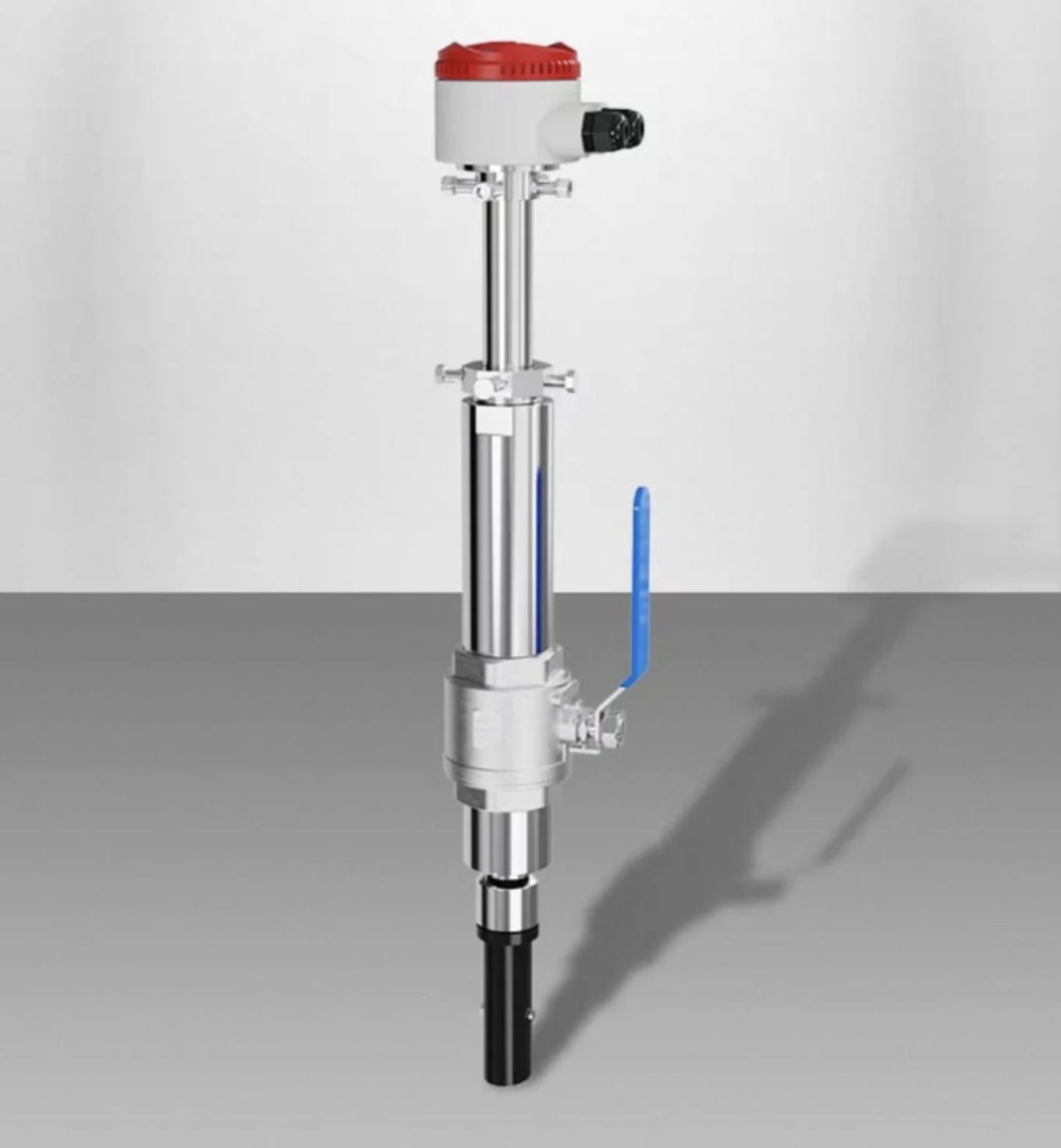
An insertion flow meter: a stainless steel probe passing through a ball valve with a blue handle, with a white transmitter head on top
Pipe size
DN100-DN3000
Accuracy
±1.5% of reading (velocity ≥1 m/s)
Outputs
RS485 Modbus RTU, 4-20 mA, pulse

Why insertion, on a large pipe

Installed without a shutdown

The probe mounts through a ball valve saddle and is inserted and removed under pressure. The main stays in service while the meter goes in, and again when it comes out for inspection.

One meter across many pipe sizes

The probe length follows the pipe diameter. The same meter covers a DN100 branch and a DN3000 main, where an inline meter would be a different instrument at every size.

Flow in both directions

Measurement is bidirectional, and the full-scale velocity is adjustable from 1 to 10 m/s to match the line.

Specifications

Pipe size DN100-DN3000
Velocity range 0-1 to 0-10 m/s (full scale 1-10 m/s, continuously adjustable)
Accuracy ±1.5% of reading (velocity ≥1 m/s)
Minimum fluid conductivity ≥30 µS/cm
Maximum fluid temperature 60 °C
Maximum working pressure 1.6 MPa
Electrode materials Stainless 316L, Hastelloy C
Outputs RS485 Modbus RTU, 4-20 mA, frequency and pulse
Sensor protection IP68
Transmitter protection IP65
Signal cable, sensor to transmitter Up to 50 m
Supply voltage 85-250 VAC (45-63 Hz) or 20-36 VDC
Power consumption Under 20 W
Ambient temperature -10 to 55 °C

Probe length by pipe size

The probe is inserted to half the pipe diameter up to DN400, and to a quarter of the diameter above that.

Pipe sizeProbe length
DN ≤200630 mm
DN250-DN400730 mm
DN401-DN1200830 mm
DN1401-DN20001030 mm

Where it gets specified

From the sensor to a record you can use

The sensor is a standard Modbus device. What it is connected to decides what the reading is worth.

On the same bus as the rest of the site

The RS485 output connects to a Genesis controller alongside every other Modbus sensor on the site. Each device has its own address, and each reading is filed against its own location.

Reported over cellular

The controller sends readings over 4G-LTE on battery, solar or a DC supply. Through an outage it holds them and sends them in order when the link returns.

A record, alerts and an API

Charts, threshold alerts to the right person, export to Excel, and a REST API for your own systems.

Or straight into your own controller

The output is standard Modbus RTU, so the sensor also reads into any PLC or controller that speaks it.
Frequently asked questions

Does the pipe have to be drained to fit it?

No. The probe mounts through a ball valve saddle and is inserted and withdrawn under pressure.

Which liquids does it measure?

Electrically conductive liquids, from 30 µS/cm. Oils, fuels and demineralised water are below that and cannot be measured this way.

Does it run on a battery?

No. The transmitter needs 85 to 250 VAC or 20 to 36 VDC and draws up to 20 W. The Genesis controller that reads it can run on its own battery and report over cellular.

How accurate is it compared with an inline meter?

It is specified at ±1.5% of reading at 1 m/s and above. An inline electromagnetic meter is tighter, and is the right choice where the pipe is small enough to take one and the line can be cut.

Tell us what needs measuring

The points, the ranges and where they sit. You get back which sensors fit and how they wire into the controller.

Talk to us →