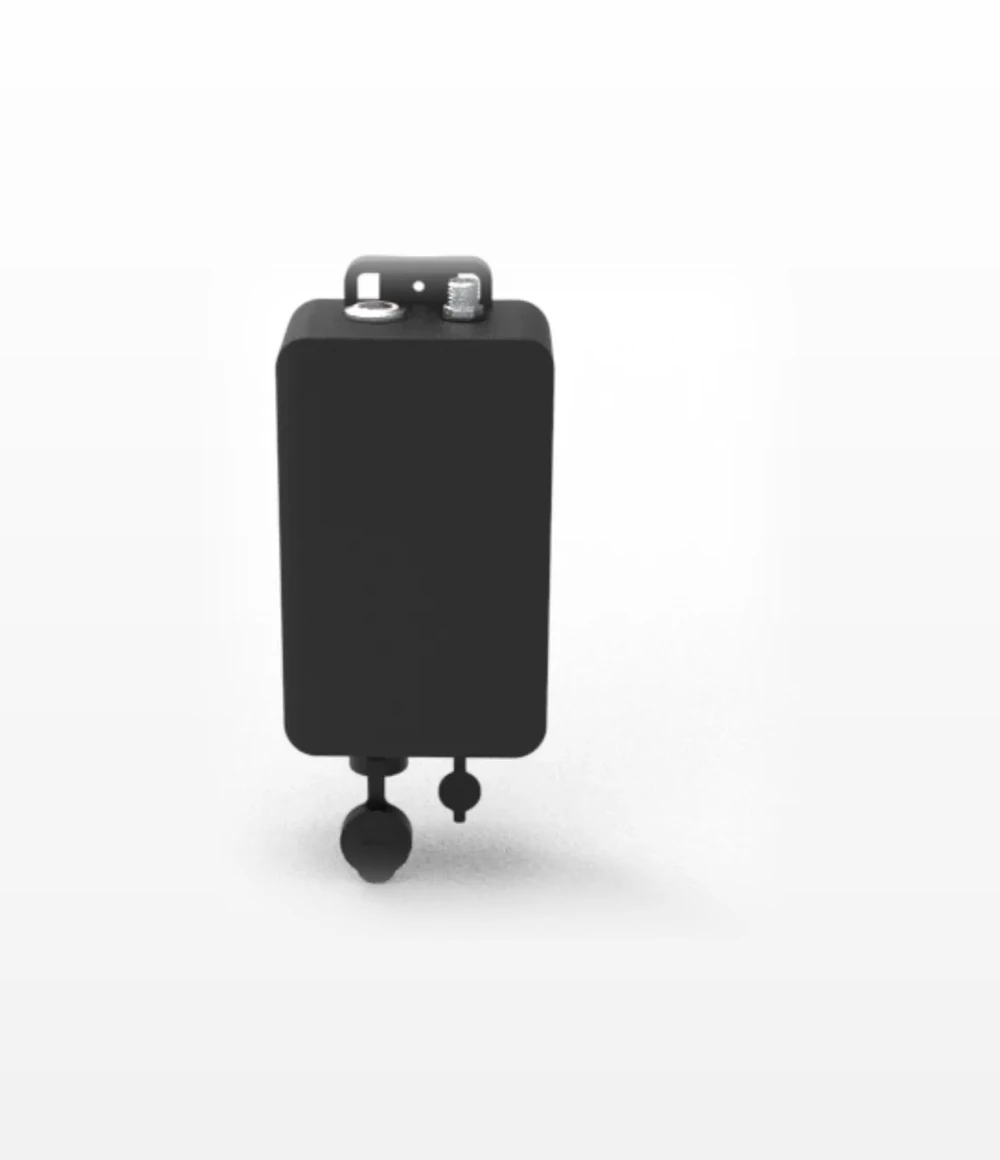
Genesis Lite controller, compact sealed enclosure with a single cabled sensor port and an antenna boss

Genesis Lite single-port IoT controller

One modular sensor port in a smaller enclosure. Not every measurement needs four ports, and Genesis Lite is the single-port version of the same controller: the same protocol list on its one port, the same cloud and open API, the same offline buffering and the same fault detection. Deploy one where a site has a single thing worth watching, and several where the points are scattered rather than clustered within cable reach.

OMNI-GENESIS-LITE

Any protocol RS485, analogue, I2C, 1-Wire, SDI-12, UART
Battery powered Solar optional
Same platform Identical cloud and API
Fault detection A bad sensor publishes an error, not a reading

What you keep, and what you give up

Lite is a smaller controller on the same platform rather than a cut-down version of it. What separates the two models is port count and power budget. The software is identical.

The same protocol list

Its single port speaks the same set as every port on the four-port unit: RS485 Modbus, analogue, digital, I2C, 1-Wire, SDI-12, UART. Assigned from the dashboard, changed without a site visit, and the port is not fixed to one sensor family at purchase.

The same cloud, the same API

Nothing is held back for the larger unit. Multi-tenant permissions, charts, reports, thresholds, alerts, device sharing across accounts, and the same open REST API with scoped tokens. A fleet mixing both models is one fleet.

A smaller power budget

A single 16340 cell rather than two 18650s, with solar as an option instead of built in. The runtime maths is the same and still set from the dashboard by transmit and collection interval, but the ceiling is lower. For a site with mains or good sun and a heavy duty cycle, size the four-port unit instead.

Cellular where you need it

Wi-Fi and Bluetooth are built in, and 4G-LTE is available for sites with no local network. The four-port unit ships cellular as its default link, so this is the one specification where the two models genuinely diverge. Specify it up front if the point is remote.

Protocols on every port

The single port takes any of these, assigned from the dashboard. The two data lines adopt the signals of whichever protocol is set.

  Port A
RS485 Modbus RTU
Analog
Digital
I2C
1-Wire
SDI-12
UART

One column instead of four, and the same full set of rows. The port is not committed to a sensor family when you order it.

Sensor power is switched 5 V or 12 V, applied only while the port is being read. Addressed RS485 devices share the bus and are read individually.

OmniCloud is included, and so is the option to ignore it

Identical to the four-port unit. Dashboard or API, whichever suits how you work, and neither route is reserved for the larger model or charged as an extra.

Use the dashboard

Multi-tenant cloud with role based permissions, charts, reports, thresholds, alerts with push notification, and device sharing across accounts so an operator and their service provider both see the same unit.

Or drive it yourself

The same open REST API with scoped service tokens: device management, port configuration, permissions, and control commands. Build your own front end or feed an existing system directly.

How multi-tenant works →

Specifications

Sensor ports 1 modular port, configured from the cloud
Protocols RS485 Modbus RTU, Analog, Digital, I2C, 1-Wire, SDI-12, UART
Sensor power Switched 5 V or 12 V, applied per reading cycle
Control output Relay, latching relay, bistable solenoid via H-bridge
Power supply Single 16340 Li-ion, 950 mAh, rechargeable
Solar and DC input 6 to 32 V DC, optional
Connectivity Wi-Fi 2.4 GHz and Bluetooth 5.0 built in, 4G-LTE cellular available
Expansion slot Takes external LoRa, LoRaWAN and GPS modules
Offline buffering Readings held locally and backfilled in order on the next successful transmit
Timekeeping On-board real-time clock, network synced, clock-aligned wake slots
Firmware updates Over the air by cellular, or locally from the device access point
Operating temperature -20 °C to +70 °C
Storage temperature -40 °C to +85 °C
Enclosure Sealed, customised PC/ABS, UV stable and weather resistant

Frequently asked questions

What is different from the four-port Genesis?

Port count and power budget. One port instead of four, a single 16340 cell instead of two 18650s, solar as an option instead of built in, and cellular available rather than default. The protocol list, the cloud, the API, the offline buffering and the fault reporting are the same.

Can I mix both models on one account?

Yes. They are one fleet in the dashboard and one fleet through the API, with the same permissions model and the same reports across both.

Is cellular included?

Wi-Fi and Bluetooth are built in, and 4G-LTE is available. Specify it when the point has no local network, because that is a configuration decided at order rather than something you add in the field.

Does it drive an output too?

Yes. Relay, latching relay and bistable solenoid over an H-bridge, the same as the larger unit. Pulse actuation is what makes that workable on a battery this size.

How long does it run between charges?

It is set by the transmit and collection intervals, both configured from the dashboard after installation, and the cell is smaller than the four-port unit so the ceiling is lower. Tell us the duty cycle you need and we will tell you which of the two fits.

One point, or a hundred scattered ones

Send the sensor model, the reading interval you need and whether the site has a network. You get back which of the two controllers fits and the reasoning behind it.

Talk to us →