Split-core RS485 current sensor

A current sensor that opens, clips around an existing cable and closes again, so a motor, a pump or a feeder is instrumented without cutting a wire or stopping the process. The conversion happens inside the sensor, and what comes out is a finished value in amps over RS485.
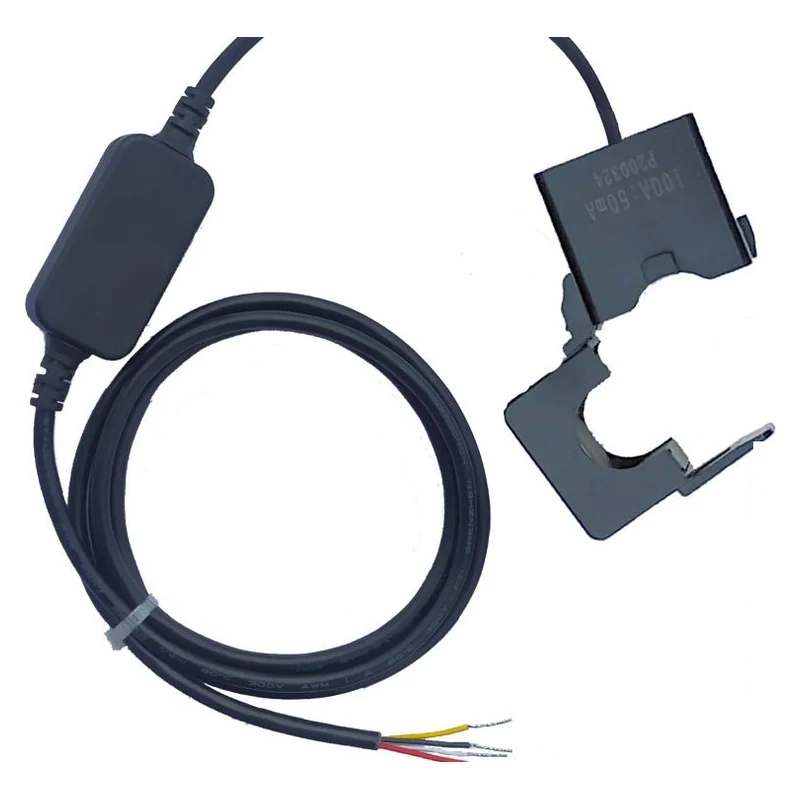
A black split-core current sensor with its clamp open, connected by a cable to a small inline transmitter with four bare wires
Measuring range
AC 0.2-100 A
Resolution
0.01 A
Output
RS485 Modbus RTU

What makes it easy to fit

No wiring interruption

The split core clips around an insulated conductor that stays connected. Nothing is cut, nothing is re-terminated, and the load keeps running while the sensor goes on.

A finished value, not a signal to scale

The sensor measures and converts internally and is calibrated across its range at production. The controller receives amps, so there is no analogue input to scale.

Several on one cable

Each sensor has its own Modbus address, so the current sensors on a row of motors share one RS485 pair back to the controller.

Specifications

Measuring range AC 0.2-100 A
Resolution 0.01 A
Line frequency 50-60 Hz
Core type Split core, clamp-on
Output RS485, Modbus RTU
Supply voltage 5-24 V DC
Power consumption 0.5 W
Cable 4-wire, 1 m standard
Housing material ABS
Operating temperature -20 to 70 °C
Storage temperature -20 to 80 °C

Extended measuring ranges are available to order. Tell us the line rating.

Where a current sensor earns its place

From the sensor to a record you can use

The sensor is a standard Modbus device. What it is connected to decides what the reading is worth.

On the same bus as the rest of the site

The RS485 output connects to a Genesis controller alongside every other Modbus sensor on the site. Each device has its own address, and each reading is filed against its own location.

Reported over cellular

The controller sends readings over 4G-LTE on battery, solar or a DC supply. Through an outage it holds them and sends them in order when the link returns.

A record, alerts and an API

Charts, threshold alerts to the right person, export to Excel, and a REST API for your own systems.

Or straight into your own controller

The output is standard Modbus RTU, so the sensor also reads into any PLC or controller that speaks it.

Reading it over Modbus

Function 0x03 reads the measurement registers. Several sensors share one RS485 pair, each with its own address.

Protocol Modbus RTU
Serial settings 9600 bps default, 8 data bits, no parity, 1 stop bit
Default address 0x01
AddressContentScaling
0x0001Current, high word32-bit value, high 16 bits
0x0002Current, low word32-bit value, low 16 bits
Request:  01 03 00 01 00 02 95 CB
Response: 01 03 04 00 00 27 10 E0 0F

The two registers are read together as one 32-bit unsigned value, high word first. Current in amps is that value divided by 100, so 0x00002710 is 10000, which is 100.00 A.

Frequently asked questions

Does the circuit have to be switched off to fit it?

No. The core opens and closes around an insulated conductor, so nothing is disconnected. Work inside a panel or on a live circuit must still be carried out by qualified personnel under the local electrical regulations.

Why does it read close to zero?

It is almost always clamped around two conductors of the same circuit, whose fields cancel. Clamp it around one conductor only, live or neutral, and close the core until the catch clicks.

Does it measure AC or DC?

AC current, at 50 to 60 Hz.

Can several current sensors share one cable run?

Yes. They share one RS485 pair, each with its own address, alongside other RS485 sensors on the same controller port.

Tell us what needs measuring

The points, the ranges and where they sit. You get back which sensors fit and how they wire into the controller.

Talk to us →