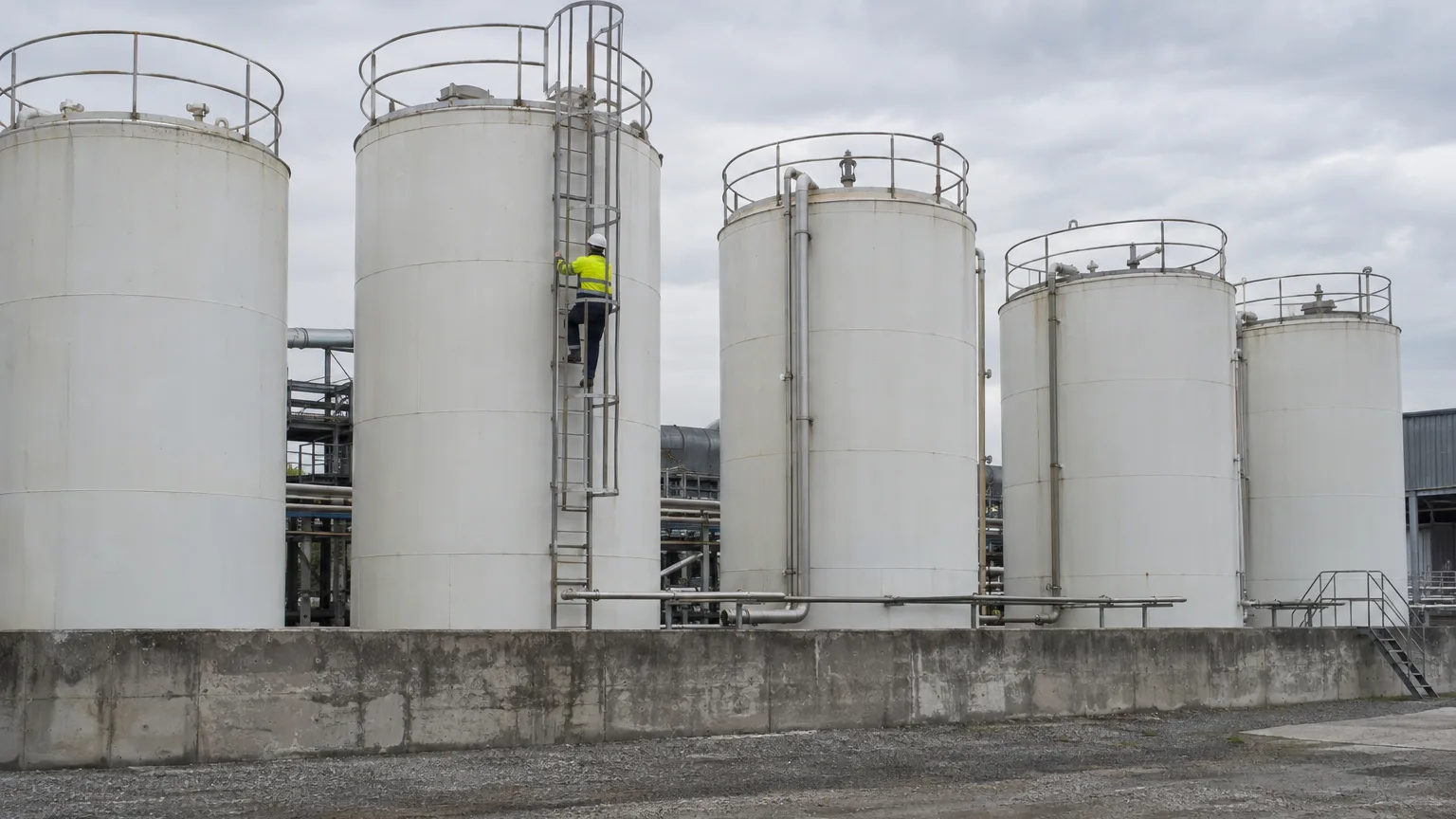
A tank is checked by someone climbing a ladder or reading a sight glass on a round, and it runs dry between rounds. A battery-powered cellular controller on each tank sends the level on a schedule, raises an alert at the low point, and leaves a record that turns guesswork about deliveries into a rate of use.
The tank was fine on Monday and empty on Thursday. A level reported every few hours catches the fall in time to order.
A schedule built on how it was always done sends a truck to a half-full tank and misses the one that emptied early.
A level that falls when nothing is drawing from the tank is a leak or a theft. It only shows when the level is recorded continuously.
| Signal | How it is read | What it tells you |
|---|---|---|
| Level | Ultrasonic or radar level sensor over RS485 | Contents, and the rate they are used |
| Level by pressure | Analogue pressure transducer at the outlet | Contents, where nothing can be mounted on the roof |
| Temperature | 1-Wire or PT1000 probe | Contents that must stay warm or cool |
| Overfill or low switch | Dry contact on a digital input | A hard limit reached, the moment it happens |
| Pump or valve | Relay output, on a rule held on the device | Top-up or transfer stopped at a level, even without the network |
Four ports on one Genesis controller, and RS485 devices share a bus, so most sites need one unit.
Minimum and maximum on each sensor, with alerts to the people on the list. Acknowledgement is recorded against the alarm, so a handover shows what was already seen.
Readings are stored on the controller with their time and sent in order when coverage returns, so the record has no gap where the incident was.
Full-resolution history, exported to Excel for a report, an insurer or a contractor, or pulled into your own system through the REST API.
A device can be shared with a service company without sharing a login, and they see nothing else on your account.
Yes. For fuel and other classified areas use a level meter in a flameproof housing; certification documentation for your market and installation is scoped per order.
That is your choice, set from the dashboard. A few readings a day sent once a day runs for years; frequent reporting needs a small solar panel.
Neither. The controller connects over 4G-LTE and runs on its rechargeable battery, with solar or a 6 to 32 V DC supply where readings need to be frequent.
Usually, yes. Over fifty sensor types are supported today and more are added on request, including RS485 Modbus instruments from their register map.
What needs watching, which instruments are already there, and whether the site has power and coverage. We come back with what a Genesis would read and what the installation involves.
Talk to us →