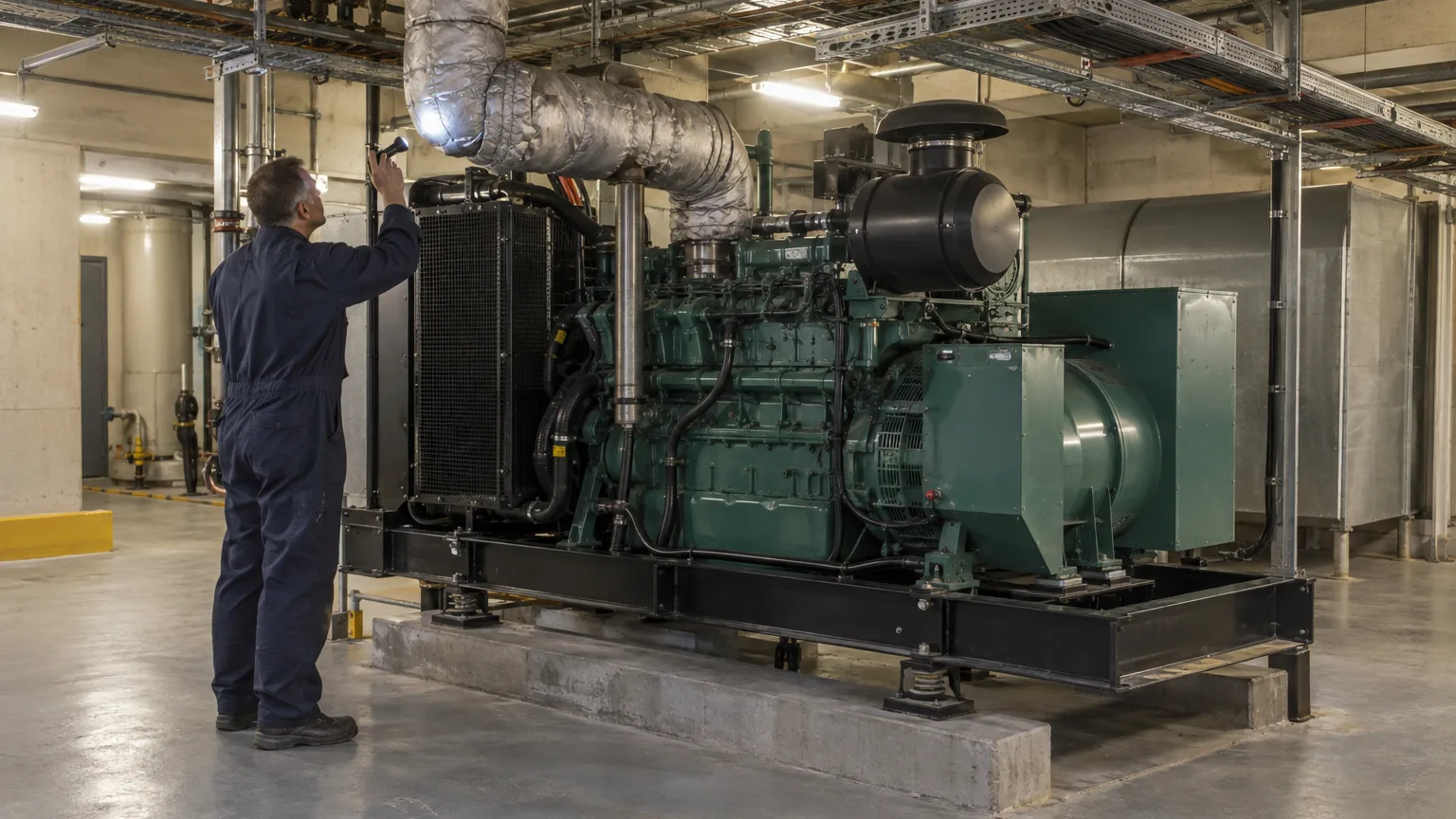
A standby generator fails between tests and nobody knows until the mains does. A controller beside the set reports fuel, run state, mains presence and the engine controller alarms over cellular, every day, so a set that will not start is found before the outage that needs it.
Fuel used in tests and lost to time is not topped up, and the set runs out partway through the outage.
An alarm on the engine controller sat on its display for weeks, in a room nobody visits between tests.
After an outage the question is when the mains failed, when the set started and what it carried. Without a record, that is a guess.
| Signal | How it is read | What it tells you |
|---|---|---|
| Fuel level | Level sensor in the day tank, RS485 or analogue | Running time left, and fuel that goes missing |
| Run state | Dry contact on a digital input | Every start and stop, and run hours |
| Mains presence | Supply sense on a digital input | When the outage began and ended |
| Output current | Clamp-on current sensor over RS485 | The load the set actually carried |
| Engine controller | RS485 Modbus RTU, from its register map | Alarms, battery voltage and its own counters |
| Room temperature | 1-Wire or PT1000 probe | A generator room that is too hot or too cold to start reliably |
Four ports on one Genesis controller, and RS485 devices share a bus, so most sites need one unit.
Minimum and maximum on each sensor, with alerts to the people on the list. Acknowledgement is recorded against the alarm, so a handover shows what was already seen.
Readings are stored on the controller with their time and sent in order when coverage returns, so the record has no gap where the incident was.
Full-resolution history, exported to Excel for a report, an insurer or a contractor, or pulled into your own system through the REST API.
A device can be shared with a service company without sharing a login, and they see nothing else on your account.
Yes. It runs on its own rechargeable battery and reports over cellular, so the outage is when it is most useful.
It can switch an output on a command, wired to a remote start input on the engine controller. Whether to allow that is the site owner's decision, and the engine controller stays in charge of the start.
Neither. The controller connects over 4G-LTE and runs on its rechargeable battery, with solar or a 6 to 32 V DC supply where readings need to be frequent.
Usually, yes. Over fifty sensor types are supported today and more are added on request, including RS485 Modbus instruments from their register map.
What needs watching, which instruments are already there, and whether the site has power and coverage. We come back with what a Genesis would read and what the installation involves.
Talk to us →