Ammonia is a pungent, toxic and corrosive gas, lighter than air, used as an industrial refrigerant and as a chemical feedstock. A large release is also flammable.
The places this cell is usually ordered for. The detector body and the wiring are the same in every one of them.
The low ranges are for occupied areas such as production floors and cold stores. The 500 and 1000 ppm ranges are for machinery rooms, where the alarm is there to start ventilation and shut the plant down.
The standard unit is 0-100 ppm at 0.1 ppm resolution. The other ranges are supplied on request.
Pick the lowest range that still covers the highest concentration you expect at that point. A lower range gives finer resolution around the alarm set points.
Ammonia is lighter than air (relative density 0.60, air = 1), so it rises and collects under the ceiling and in roof voids. Mount the detector high, 0.3 to 0.6 m below the ceiling, above the likely release point.
Keep the detector clear of splashing water, oil and mechanical impact, and leave room around it to open the cover for calibration.
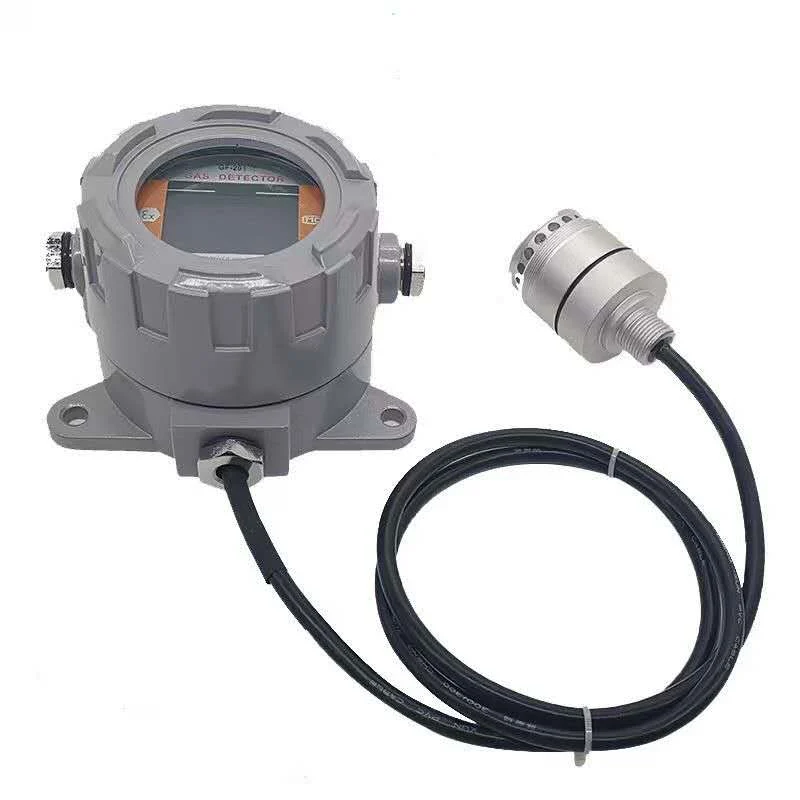
One detector body across the whole family. The sensing cell inside sets the target gas and the range.
| Target gas | Ammonia (NH3) |
|---|---|
| Selectable ranges | 0-50 / 100 / 200 / 500 / 1000 ppm |
| Resolution | 0.01 / 0.1 / 1 ppm |
| Response time (T90) | ≤30 s |
| Sensor | Replaceable ammonia sensing cell |
| Accuracy | ≤±3% FS |
| Repeatability | ≤±1% |
| Sampling | Diffusion, pump suction optional |
| Analogue output | 4-20 mA, 3-wire (2-wire optional) |
| Digital output | RS485, Modbus RTU |
| Alarm outputs | Two relays, normally open, AC 120 V 0.5 A / DC 24 V 1 A |
| Supply | 24 VDC (12 to 30 VDC), 2 W or less |
| Display | LCD with backlight |
| Enclosure | Flameproof aluminium alloy, IP65 |
| Cable entry | M20×1.5 internal thread |
| Mounting | Wall mount or pipe flow-through |
| Operating conditions | -20 to 50 °C, 10 to 95% RH non-condensing |
| Dimensions and weight | 196 × 140 × 91 mm, 1.2 kg |
These are United States values. Limits differ by country, and alarm set points are decided by the site against its own regulations and risk assessment.
| NIOSH recommended exposure limit (REL) | TWA 25 ppm (18 mg/m³) ST 35 ppm (27 mg/m³) |
|---|---|
| OSHA permissible exposure limit (PEL) | TWA 50 ppm (35 mg/m³) |
| Immediately dangerous to life or health (IDLH) | 300 ppm |
TWA is a time-weighted average over a working shift, ST a short-term limit, C a ceiling that should not be exceeded, and Ca marks a substance NIOSH treats as a potential occupational carcinogen.
Gas detection has a requirement most sensors do not: the alarm must work when the network does not. The cloud is layered on top of the local interlock, and never replaces it.
Two configurable alarm relays per detector, normally open dry contacts. Fans, solenoid valves and sirens trip locally with no network involved.
The analogue loop feeds a PLC, a DCS or an existing alarm panel directly, so the detector drops into an installed base without replacing it.
The digital reading goes over Modbus RTU into our industrial IoT controllers, on the same bus as the other sensors on the site, and from there to the cloud over cellular.
Concentration charts, threshold alerts to the right person, an exportable log of every excursion, and a REST API for your own reporting system.
The RS485 output is half duplex Modbus RTU. Several detectors share one twisted pair, each with its own address.
| Protocol | Modbus RTU |
|---|---|
| Serial settings | 9600 bps, 8 data bits, no parity, 1 stop bit |
| Default address | 0x01, set from the front panel menu |
| Read function | 0x03, read holding registers |
| Address | Content | Type | Scaling |
|---|---|---|---|
| 0x0000 | Gas concentration | UINT16 | Value ÷ 10^decimals |
| 0x0011 | Decimal places | UINT16 | Direct, 0 to 3 |
| 0x0013 | Full-scale range | UINT16 | Value ÷ 10^decimals |
Request: 01 03 00 00 00 01 84 0A
Response: 01 03 02 00 FD 79 C5 On the standard unit the decimal places register reads 1, so a raw value of 253 is 25.3 ppm. Read register 0x0011 once on any unit to confirm its scaling.
Lighter. Its relative density is 0.60 against 1 for air, so it rises. The detector is mounted high, 0.3 to 0.6 m below the ceiling, above the likely release point.
0-50 / 100 / 200 / 500 / 1000 ppm, with a resolution of 0.01 / 0.1 / 1 ppm. The sensing cell sets the range, so it is chosen when the detector is ordered.
Both words get used for it. The sensor is the sensing cell inside, which reacts to the gas. The detector is the complete instrument around it: the housing, the display, the alarm relays and the outputs. What is described here is the complete detector, with the ammonia sensor cell fitted.
No. The two relays are driven locally by the detector against its configured set points. Ventilation, shut-off and sirens trip even when connectivity is down. The cloud adds the record, remote visibility and escalation on top.
The detector outputs 4-20 mA, RS485 Modbus RTU and two alarm relays at the same time. The Modbus output connects to a Genesis controller alongside the other sensors on the site, and the controller sends the readings over cellular for charts, alerts and the REST API. The analogue loop and the relays keep serving the existing panel and the local interlock.
At least once every six months. Calibration is done from the front panel menu by trained personnel with certified gas: a zero, then a span near half of full scale. The sensing cell is replaced at end of life without changing the installation.
The detectors are built in flameproof aluminium enclosures designed for hazardous area installation, sealed to IP65. Certification documentation for your market and installation class is scoped per order.
How many ammonia points, at what range, and which panel or controller they report into. We come back with the cell and range to specify and how the detectors wire into what is already there.
Talk to us →